
Learn How to Complain Like a Real French Person 🇫🇷
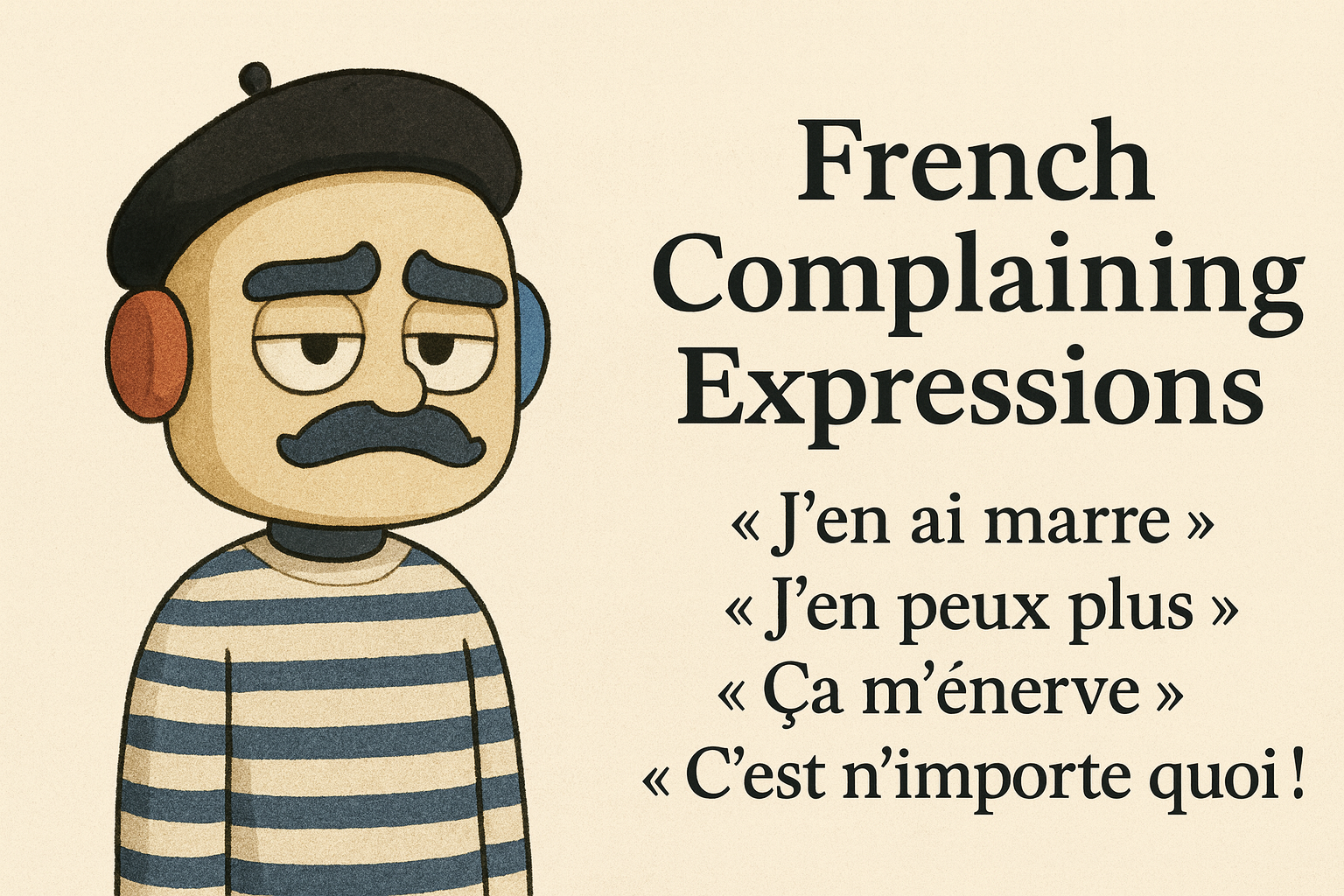
If you’ve been learning French for a while, you probably know how to say bonjour, merci, and s’il vous plaît. But let’s be honest: that won’t help you much when the train is late, the coffee is bad, or someone cuts in line.
To truly sound French, you need to know how to complain.
Complaining in French isn’t just about being negative — it’s a social skill. It’s how French people bond, express frustration, and show emotion. Today, let’s look at some very real French expressions you’ll hear every day… and that you can start using right away.
“J’en ai marre” – I’ve had enough
This is probably one of the most useful French expressions ever.
J’en ai marre means “I’m fed up”, “I’ve had enough”, or “I’m so done with this.”
You can use it for almost anything:
- J’en ai marre de travailler. (I’m fed up with working.)
- J’en ai marre de ce temps. (I’m fed up with this weather.)
- J’en ai marre ! (Just… I’m fed up.)
It’s informal, emotional, and very French. If you say this naturally, you already sound much less like a textbook.
“C’est nul” – This sucks
Short, simple, and brutally honest.
C’est nul means “It’s rubbish,” “It’s terrible,” or “This sucks.”
French people use it all the time:
- Ce film est nul. (This movie is awful.)
- Ce restaurant, c’est nul. (This restaurant sucks.)
- Franchement, c’est nul. (Honestly, it’s rubbish.)
It’s informal, so don’t use it in a job interview — but with friends, it’s perfect.
“Non mais quoi encore ?!” – What now?! / You’ve got to be kidding me
This one is pure French drama.
Non mais quoi encore ?! is what you say when something else goes wrong and you’re completely over it.
Think:
- Your train is late again
- The website crashes again
- Someone asks you for one more thing when you’re exhausted
It roughly means:
“What now?!”
“You’ve got to be kidding me.”
Tone is everything here — the more exasperated, the better.
“C’est pas possible” – This is unbelievable
Another classic.
C’est pas possible literally means “It’s not possible,” but in real life it often means:
- “This is unbelievable.”
- “This is ridiculous.”
Example:
- Il est encore en retard ? C’est pas possible.
(He’s late again? This is unbelievable.)
Very common, very French, and easy to use.
“J’hallucine” – I can’t believe this
If something shocks or annoys you, this one is perfect.
J’hallucine means “I’m hallucinating”, but really it means:
“I can’t believe this.”
Example:
- Ils ont encore augmenté les prix ? J’hallucine.
(They raised the prices again? I can’t believe it.)
It’s informal, expressive, and extremely natural.
That’s exactly the kind of everyday, emotional French I teach in my French for Social Life course — the stuff you hear outside textbooks.
If you’re starting French from scratch, you can download my free French Starter Pack right here.
Why learning these expressions matters
If you only learn “perfect” French, you may be understood — but you won’t sound natural.
Expressions like j’en ai marre, c’est nul, or non mais quoi encore are what real people use every day. They help you:
- understand native speakers better
- express emotions naturally
- feel more confident in real conversations
And yes… they also help you complain properly 😉
Want to sound more French (even when complaining)?
At learnfrenchwithpauline.com, I teach the kind of French you actually hear — not just grammar rules, but real expressions, real pronunciation, and real-life situations.
If you want to:
- stop sounding like a textbook
- understand spoken French more easily
- speak with confidence and authenticity
👉 Check out my courses and lessons on learnfrenchwithpauline.com and start speaking French like a real person — even when you’re fed up.
Moi aussi j’en ai marre parfois, mais tout le monde s’en fout 😉
I’m also fed up sometimes, but nobody gives a flying f…